Synthesized is a well-engineered platform. If you are looking for a tool to mask, subset, or scale up data that already exists in a production database you can connect to, it handles that workflow with genuine sophistication. The TDK CLI is solid. The YAML configuration model is expressive. The subsetting engine is one of the better implementations in the market.
But the moment you step outside that workflow, the gaps become structural, not cosmetic.
This post is a direct, honest comparison of Synthesized and SyntheholDB for engineering teams who need production-realistic synthetic databases and want to understand which tool actually fits their situation.
What Synthesized Actually Does
Synthesized operates as a transformation pipeline between a source database and a destination database. The core workflow is: connect to production, analyze schema and data patterns, apply a transformation (mask, generate, or subset), write to a destination.
The platform offers three core capabilities:
Database masking replaces sensitive values with realistic but fake alternatives using 35-plus built-in transformers. Names, emails, SSNs, credit card numbers, and other PII fields are replaced at the column level while preserving row-level continuity and referential integrity.
Database generation uses the source database schema and data distribution as the model. The TDK learns statistical distributions from your production data and generates additional rows that match those distributions. The target ratio configuration lets you scale a production dataset to any multiple.
Database subsetting extracts a representative slice of production data, 10%, 25%, or 50%, while preserving referential integrity across linked tables. For teams that need a smaller but structurally valid version of production data, this is a genuinely useful capability.
The SDK adds a Python-native layer for ML teams who need data rebalancing, imputation, and augmentation for model training pipelines. The claimed uplift of up to 15% model performance improvement from data rebalancing is the kind of claim that resonates with data science teams running classification models on imbalanced datasets.
All of this is coherent and well-executed for its intended use case.
The Structural Dependency That Changes Everything
The Synthesized workflow has one requirement that shapes every other decision: it needs a source database to connect to.
Every generation mode in the TDK, whether masking, subsetting, or statistical generation, begins with a connection to a source. The platform analyzes that source, learns its schema and distributions, and uses that learning to produce the output.
This means:
If you are a healthtech startup building a clinical product and you do not have a production clinical database yet, Synthesized cannot generate data for you.
If you are a pharma engineering team building a pipeline for a new therapeutic area that your institution has not collected data for, Synthesized cannot generate that population.
If you are a CRO technical team that needs to give a vendor partner a realistic clinical database for integration testing without sharing any production data, Synthesized’s transformation pipeline starts from a source you cannot share.
If you are building a new product line in fintech, insurance, or healthcare and need realistic data for demos, staging, and CI before your first customer is onboarded, the tool that requires a production source cannot help you.
SyntheholDB generates complete, production-realistic databases from statistical models without ever touching production data. There is no source connection. There is no production dependency. There is no data transfer to configure, secure, or audit.
The YAML Configuration Layer
Synthesized uses a declarative YAML configuration model that the company calls “Data as Code.” For teams with strong DevOps culture and experience managing infrastructure-as-code, this is a genuine workflow advantage. Configurations are version-controlled, reviewable, and reproducible.
For teams that are not primarily infrastructure engineers, the YAML layer is overhead that sits between the team and the synthetic database they need.
Consider the typical onboarding path for a new engineer who needs a realistic test database for a feature branch. With Synthesized TDK, the path is:
Install the TDK CLI. Clone the tutorial databases repository. Configure Docker Compose to start local PostgreSQL instances. Write or generate a YAML configuration file defining the transformation mode, target ratios, table-level overrides, transformer specifications for each column type, and safety mode settings. Run the TDK with source and destination JDBC connection strings. Debug configuration errors against the schema validation output.
That path is manageable for a senior data engineer who owns the test data infrastructure. It is a meaningful barrier for a backend developer who needs a database this afternoon.
SyntheholDB takes a different approach. Describe your schema in plain English or import a SQL DDL file. Configure the population size. Generate. The entire interaction is a conversation with a generation pipeline, not a YAML authoring exercise.
Domain Knowledge vs Statistical Learning
Synthesized learns distributions from production data. When it generates additional rows, it is sampling from the statistical model it built from your source database. This produces output that faithfully reflects the patterns in your actual production data.
This is a strength when your production data is the right reference. It is a limitation when:
Your production data has historical biases you do not want to reproduce in your test environment. A model trained on your production distribution will faithfully reproduce underrepresented populations, historical coding errors, and whatever anomalies your production system accumulated over time.
Your production data does not yet contain the scenarios you need to test. Edge cases, rare disease presentations, atypical transaction patterns, low-frequency but high-severity events: if they are rare in production, they will be proportionally rare in the Synthesized output unless you manually configure conditional overrides.
Your production data does not exist for the use case you are building. No production source means no learned distribution means no output.
SyntheholDB uses domain-specific statistical models built from clinical, financial, and enterprise data standards. These models understand that a Type 2 diabetes patient should have a correlated prescription history, that an HbA1c result should fall within a range consistent with their diagnosis severity, that a high-value transaction should trigger a correlated risk event. This domain knowledge is built into the generation engine, not learned from whatever production data you happen to have available.
Edge Case Coverage as a First-Class Feature
Clinical, financial, and regulated industry data is defined by its edge cases. The patient with 14 overlapping prescriptions. The transaction that matches three different fraud pattern signatures simultaneously. The insurance claim where the procedure code is valid but the diagnosis code pairing is clinically implausible.
Synthesized generates data that reflects the distribution of your production database. If those edge cases appear in production at 0.3% frequency, they will appear in the Synthesized output at approximately 0.3% frequency. At a test dataset size of 10,000 records, that is 30 edge case instances, which may be enough to catch the obvious failures but not the subtle ones.
SyntheholDB generates edge cases by design. The generation pipeline includes anomalous but domain-valid patterns as a configurable first-class feature, not as a low-probability byproduct of statistical sampling. You define the edge case coverage you need. The engine generates it.
The Cold Start Problem for New Products
There is a specific scenario where the production-dependency of Synthesized creates a complete blocker: building a product before you have customers.
Every healthtech company, fintech startup, and enterprise software team building in a regulated vertical faces this moment. You need realistic data to build the product. You need the product to get the first customer. You need the customer to get the data.
Synthesized cannot break this cycle. Its value proposition requires a source database to analyze. No source, no generation.
SyntheholDB breaks this cycle on day one. Start from a pre-built domain template, import a schema definition, or describe your data model in plain English. Generate a production-realistic database before your first customer conversation. Build your entire product on realistic data from the first line of code.
This is not a minor convenience. For regulated industry products where the difference between a realistic demo and a toy demo determines whether you get the pilot, the ability to generate realistic data without a production source is a competitive advantage.
CI/CD Integration: Two Different Models
Both platforms support CI/CD integration. The practical experience is meaningfully different.
Synthesized CI/CD integration works by running the TDK transformation pipeline in your pipeline, connecting to a source database, applying the configured transformations, and writing to the destination. This means your CI pipeline needs network access to a source database, a configured and maintained YAML transformation file, and a destination database to write to. The pipeline is fast, but the dependencies are real.
SyntheholDB on Pro and above supports API-driven generation with a deterministic seed. Your CI pipeline calls the generation API with a schema identifier and a seed value. The same seed produces the same database on every run. No network access to a source database. No transformation configuration to maintain. No production dependency in your pipeline at any point.
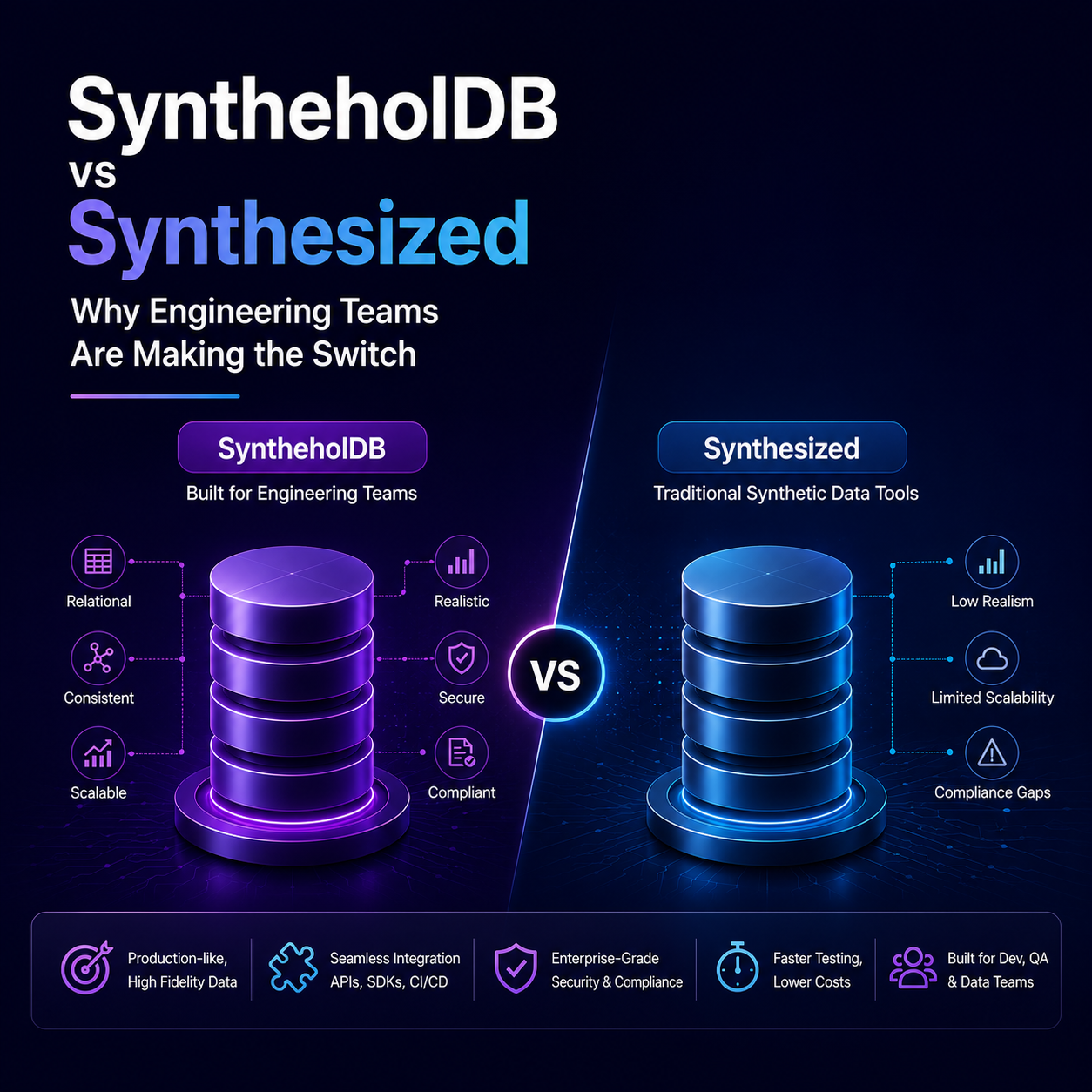
Head-to-Head Comparison
| Dimension | SyntheholDB | Synthesized |
|---|---|---|
| Production data required | Never | Required as source for generation and masking |
| Generation from scratch | Full schema, from plain English or DDL | Requires source database to learn distributions from |
| Domain-aware clinical correlations | Built into generation models | Learned from production data if available |
| Edge case generation by design | Configurable, first-class feature | Proportional to production distribution |
| CI/CD integration | API-driven, deterministic seed, no source DB needed | TDK CLI with source DB connection required |
| Configuration model | Conversational, plain English or DDL | Declarative YAML with 35-plus transformer types |
| Cold start for new products | Fully supported on day one | Not applicable without production source |
| Domain templates | Healthcare EHR, financial, custom | Not available, requires source schema |
| Compliance certifications | SOC 2 Type II, ISO 27001, HIPAA, GDPR | Enterprise plans, certifications not publicly listed |
| Fidelity and privacy reports on every export | Standard across all tiers | Available via platform reporting |
| Time to first database | Under 60 seconds, free tier | Requires TDK setup, Docker, source DB configuration |
| Pricing transparency | Free tier, $99/month Pro, Enterprise published | Not publicly listed, requires contact |
| SAP integration | Not applicable | Native SAP TDM support |
| ML data rebalancing and imputation | Not the primary use case | Available via SDK |
When Synthesized Is the Right Choice
This comparison exists to help teams make the right decision, not to dismiss a tool that serves a real need.
Synthesized is the right choice when your team has an existing production database, needs to mask it for compliance, subset it for developer environments, or scale it for load testing. If your primary workflow is transforming production data rather than generating data without a production source, the TDK is well-suited to that workflow.
Synthesized is also the right choice for teams with SAP infrastructure who need native SAP TDM support. SyntheholDB does not serve that use case.
If your ML pipeline needs data rebalancing, imputation, and augmentation for model training on tabular data, the Synthesized SDK is purpose-built for that use case in a way that SyntheholDB is not.
When SyntheholDB Is the Right Choice
SyntheholDB is the right choice for every scenario where you need production-realistic data without a production source.
Building a new product before your first customer. Generating clinical data for a therapeutic area you have not served yet. Creating a realistic database for a CRO or vendor partner without sharing production data. Running a CI pipeline that cannot depend on a live source database connection. Testing edge cases at a coverage level that production data distribution cannot provide. Onboarding a developer in under 60 seconds without a TDK setup, Docker configuration, or YAML authoring exercise.
SyntheholDB is also the right choice for teams in regulated industries where the compliance posture of a tool that never touches production data simplifies audit conversations significantly. Every generation is documented: fidelity score, privacy label scan, and referential integrity report included with every export. SOC 2 Type II certified, ISO 27001 certified, HIPAA and GDPR compliant.
Start Free Today
SyntheholDB is free to start. No credit card required. Your first synthetic database is ready in under 60 seconds.
Sign up here: https://db.synthehol.ai/#/login
If you have been running Synthesized for production transformation workflows and are looking for a complementary tool for the new product, new data domain, or no-production-dependency use cases, drop a comment below. These two tools solve different problems and the teams getting the most value from SyntheholDB often have both in their stack for different purposes.