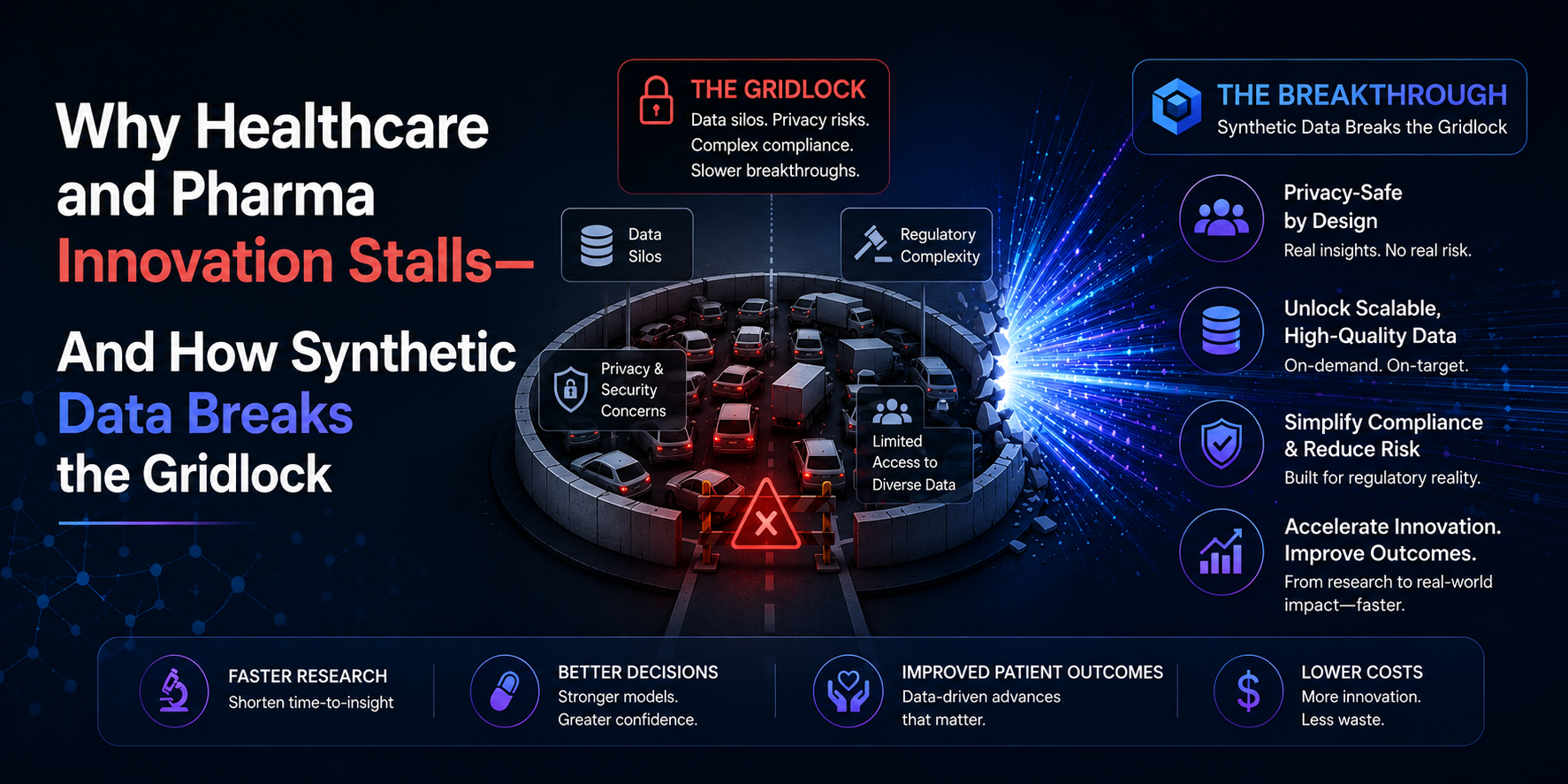
Why Healthcare and Pharma Innovation Stalls
Last week, I had a deeply insightful conversation with a group of seasoned life sciences professionals—CROs, clinical trial auditors, quality leads, and physicians with decades of experience across leading pharma and biotech companies spanning Phase I through Phase III trials.
The conversation wasn’t about technology for technology’s sake. It was about a real, recurring operational problem that every healthcare and pharma organization faces:
You know the use case. You have the hypothesis. You can see the value. But you can’t access the data.
The Data Gridlock in Healthcare
Here’s what we heard, condensed into three painful realities:
1. Data scarcity when you need it most
Clinical trials often begin with limited patient enrollment. Imagine running a Phase I trial targeting 20 subjects, but only 4 have enrolled. Your analytics, modeling, and monitoring workflows are starved for data. You can’t validate your assumptions. You can’t test your systems. You can’t demonstrate proof-of-concept to stakeholders.
2. Regulatory and privacy barriers that delay everything
HIPAA. IRB approvals. Internal governance layers. Cross-organizational data sharing agreements. Even when data exists, accessing it for development, testing, vendor demos, or AI training can take months—if it’s approved at all.
The reality? Teams often know exactly what they need. But compliance frameworks make “just get me the data” nearly impossible.
3. Data movement challenges across organizations
For vendor teams, CROs, or product builders working across multiple sponsors, moving data between environments is blocked by governance. Teams end up rebuilding the same logic over and over because data can’t travel safely.
What We Learned: The Real Demand Signal
During the call, one participant asked a clarifying question that crystallized the entire conversation:
“If we have a trial with only 4 enrolled subjects but need to simulate 20 or 30 for feasibility analysis—can synthetic data do that?” Yes. That’s exactly the kind of problem synthetic data solves.
But more importantly, the question revealed something deeper: the market needs a way to generate enterprise-grade, relational, statistically realistic datasets without requiring production data access at all.
How SyntheholDB Solves This
This is where SyntheholDB becomes strategically valuable for healthcare, pharma, and med-tech organizations.
1. Generate data from prompts, schemas, or limited samples
SyntheholDB gives teams three flexible starting points:
- Extrapolate from small samples (like those 4 enrolled patients) to create larger, realistic cohorts
- Generate from schema alone when you have the structure but can’t access live data
- Build from natural language prompts when designing new trials, monitoring workflows, or analytics use cases from scratch
2. Preserve referential integrity across tables
SyntheholDB understands table relationships, foreign keys, dependencies, and generation order.
When you generate a synthetic EHR database with patients, encounters, diagnoses, prescriptions, and trial eligibility tables, the system ensures:
- Encounters only exist when patients exist
- Prescriptions correctly link encounters, medications, and patients
- Patient diagnosis tables maintain proper foreign key relationships
The result? Data that behaves like real data when you query it, join it, or run analytics on it.
3. Tune correlations for domain realism
SyntheholDB includes a correlation studio where teams can inspect and adjust relationships between columns and across tables.
Healthcare data is full of domain-specific relationships: age correlates with comorbidity count, state influences treatment access, encounter type affects prescription frequency.
Teams can see those relationships, adjust them, and regenerate until the synthetic data matches the real-world behavior they need to model.
4. Catalog-level transparency for audit readiness
Every generation comes with a detailed catalog:
- Row, column, and table counts
- Table reference mappings
- Distribution summaries and relationship validation
- Version history for complete traceability
For regulated environments where auditability and transparency are non-negotiable, this built-in governance layer accelerates adoption.
Real Use Cases Healthcare Teams Are Solving
Clinical Trials & Research
- Trial feasibility analysis when enrollment is incomplete
- Synthetic control arms for faster comparisons
- Protocol simulation to test scenarios across demographics, sites, or treatment variations
- Imbalance detection and bias mitigation before trials scale
Operational & Monitoring Workflows
- CRO reporting and analytics dashboards that can’t use live sponsor data
- Audit scenario testing for quality, compliance, and site monitoring teams
- Vendor product development when clients can’t share production PHI
AI, Analytics & Product Innovation
- EHR-like sandbox data for training AI models, testing algorithms, and validating hypotheses
- Faster pilot cycles because teams don’t wait months for data access approvals
- Client-facing demos that look real without exposing sensitive information
Cross-Organizational Collaboration
- Data sharing between sponsors, CROs, and health systems when governance blocks live data movement
- Multi-site analytics where pooling real data is legally or operationally impossible
Why This Matters Now
The healthcare and life sciences industry is at an inflection point. AI, real-world evidence, precision medicine, and patient-centric trials all depend on faster access to better data.
Synthetic data infrastructure—when built for enterprise needs—decouples innovation speed from data access friction.
It lets teams:
- Build before they have full data access
- Test before they have scale
- Prove value before they expose risk
- Collaborate across organizational boundaries safely
Final Thought: Solving for Clinical Data Specifically
During the call, a seasoned auditor emphasized:
“Can we focus the discussion on clinical data specifically? That’s where we see the most friction.” That singular focus—clinical data, not just any healthcare data—is where real commercial value lives.
Because clinical data is:
- The hardest to access
- The most regulated
- The most valuable for innovation
- The highest priority for AI and analytics initiatives
If you’re leading innovation, analytics, AI, or product development in healthcare, pharma, or med-tech—and data access is your bottleneck—SyntheholDB is built to solve this.
SyntheholDB provides enterprise-grade synthetic data infrastructure designed specifically for regulated environments where privacy, speed, and statistical fidelity can’t be compromised.
Learn more: synthehol.ai
Leave a Reply