Synthetic data platforms came of age in a world where the hardest problem was getting enough tabular data to train models. Tools like YData were built for that world: they focus on single tables, model‑ready datasets, and data‑centric AI workflows.
Today, the teams buying synthetic data are dealing with a different reality:
- AI systems embedded deep inside products and microservices
- Regulated environments where PII and auditability are critical
- Dev, QA, and staging environments that must behave like production without using production
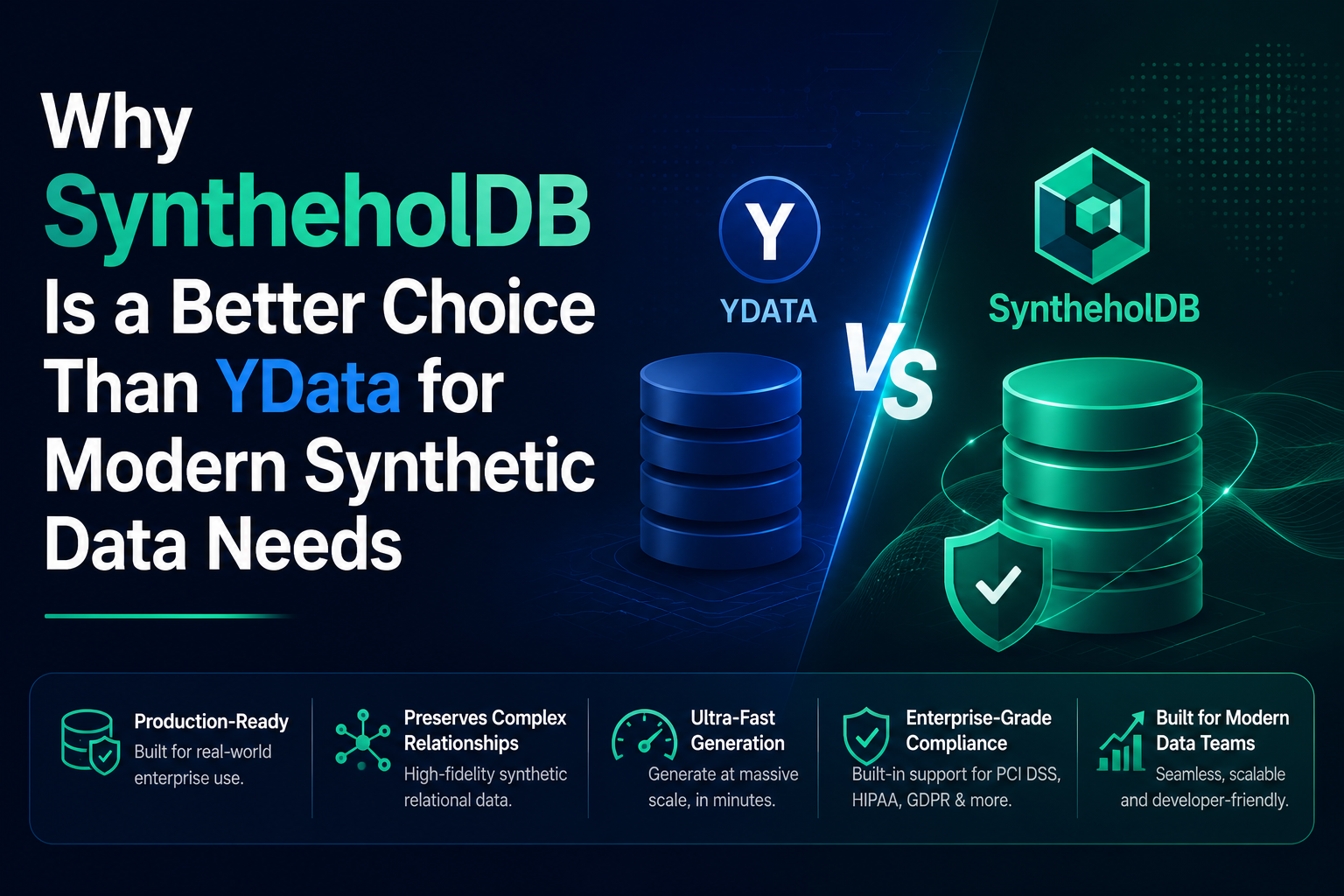
In that reality, SyntheholDB is simply a better choice than YData. It is designed for synthetic data as infrastructure, not just as an experiment.
This article explains why.
1. YData Solves Yesterday’s Synthetic Data Problem
YData focuses on datasets:
- Load a table
- Profile columns and correlations
- Train a generator
- Produce a synthetic dataset that approximates the original statistically
That’s useful when your main question is: “How do we get more training data for our model without exposing real records?”
It is less useful when your questions become:
- “How do we get a realistic, safe database for our app, pipelines, and agents?”
- “How do we keep our non‑prod environments compliant without cloning production?”
- “How do we give auditors synthetic environments that mirror production behavior, not just column stats?”
YData doesn’t really try to solve those; it stays in the dataset lane. That was enough five years ago. It isn’t enough for where synthetic data is now headed.
2. SyntheholDB Treats Synthetic Data as Infrastructure, Not Just a Dataset
SyntheholDB starts from a different premise: synthetic data is no longer just a file you hand to a data scientist. It is infrastructure your whole stack relies on.
That shows up in three fundamental design choices.
a) Databases, not just tables
SyntheholDB is built to generate complete databases, not isolated tables:
- You start from a schema (your own, a template, or a natural‑language description).
- It generates all tables together, keeping primary keys, foreign keys, and relationships coherent.
- Customers, accounts, transactions, claims, events, and logs all line up and tell consistent stories.
YData can give you synthetic rows for a table. SyntheholDB gives you a synthetic backend your application can actually run against.
b) Behavioural realism, not only statistical similarity
YData optimises for column‑level and table‑level statistics. SyntheholDB optimises for system behaviour:
- Customers sign up, transact, and churn over realistic timelines.
- Policies start, renew, lapse.
- Loans are disbursed, repaid, or defaulted, with probabilities that vary by segment and product type.
- Events and logs follow plausible sequences tied to business flows.
If you plug YData’s outputs into a complex application, you often get data that looks fine in a profile but doesn’t behave like your system. Plug SyntheholDB’s outputs in, and integration tests, microservices, and agents experience something that feels like production.
c) Privacy and governance by construction
Cloning and masking production databases for non‑prod is the quiet risk most organisations carry.
SyntheholDB eliminates that risk by design:
- Every row is generated from models, not copied from production.
- There is no dependency on raw customer data for dev, QA, staging, or demos.
- You can attach governance layers (audit trails, scenario labels, temporal constraints) directly to synthetic databases.
YData’s outputs still leave you figuring out what to do with the rest of the database. SyntheholDB replaces the database entirely, with privacy baked in, not bolted on.
3. One Product Family for Datasets and Databases
There is another practical reason SyntheholDB is a better choice: Synthehol already gives you both layers.
- Synthehol.ai covers synthetic datasets for AI/ML training and analytics.
- SyntheholDB covers synthetic databases for applications, pipelines, and governance.
That means:
- You don’t have to pick a separate vendor for dataset work and another for database work.
- You get a consistent privacy, quality, and governance philosophy across both.
- You can move from “we need a synthetic dataset for a model” to “we need a synthetic database for a product” without leaving the ecosystem.
With YData, you still have to solve the database problem elsewhere. With Synthehol, you solve both with one stack.
4. Where SyntheholDB Is Clearly the Better Choice
If you ask a blunt question — “In which situations is SyntheholDB simply the better option than YData?” — the list is very straightforward:
- You need to seed dev, QA, and staging databases with realistic data that matches your schema.
- You run microservices that depend on shared relational data and need synthetic environments for integration testing.
- You build AI products or agents that operate across entities and tables, not just single datasets.
- You are in a regulated industry and cannot justify cloning production databases into non‑prod, even with masking.
- You want synthetic audit environments that mirror production schemas and behaviour for governance and replay.
YData does not meaningfully address those needs. SyntheholDB is purpose‑built for them.
For teams operating in BFSI, insurance, healthtech, RegTech, and enterprise SaaS, those are not edge cases; they are daily realities. In that context, SyntheholDB isn’t just an alternative — it is the right tool.
5. The Strategic Difference: Experiments vs Systems
The simplest way to summarise the difference is this:
- YData is a good tool for experiments.
It helps data scientists generate and explore synthetic datasets. - SyntheholDB is a better tool for systems.
It helps engineering, AI, and compliance teams run real applications and governance processes on synthetic databases.
If your organisation is still at the “we need synthetic data for model experiments” stage, YData can be adequate.
If you are at the “synthetic data is part of our infrastructure, and we need to trust it for apps, tests, and regulators” stage, SyntheholDB is a better choice.
That is the reality the article should convey: not that YData is bad, but that for modern, production‑grade synthetic data in regulated and complex environments, SyntheholDB is the superior option.
Leave a Reply