Tag: SyntheholDB

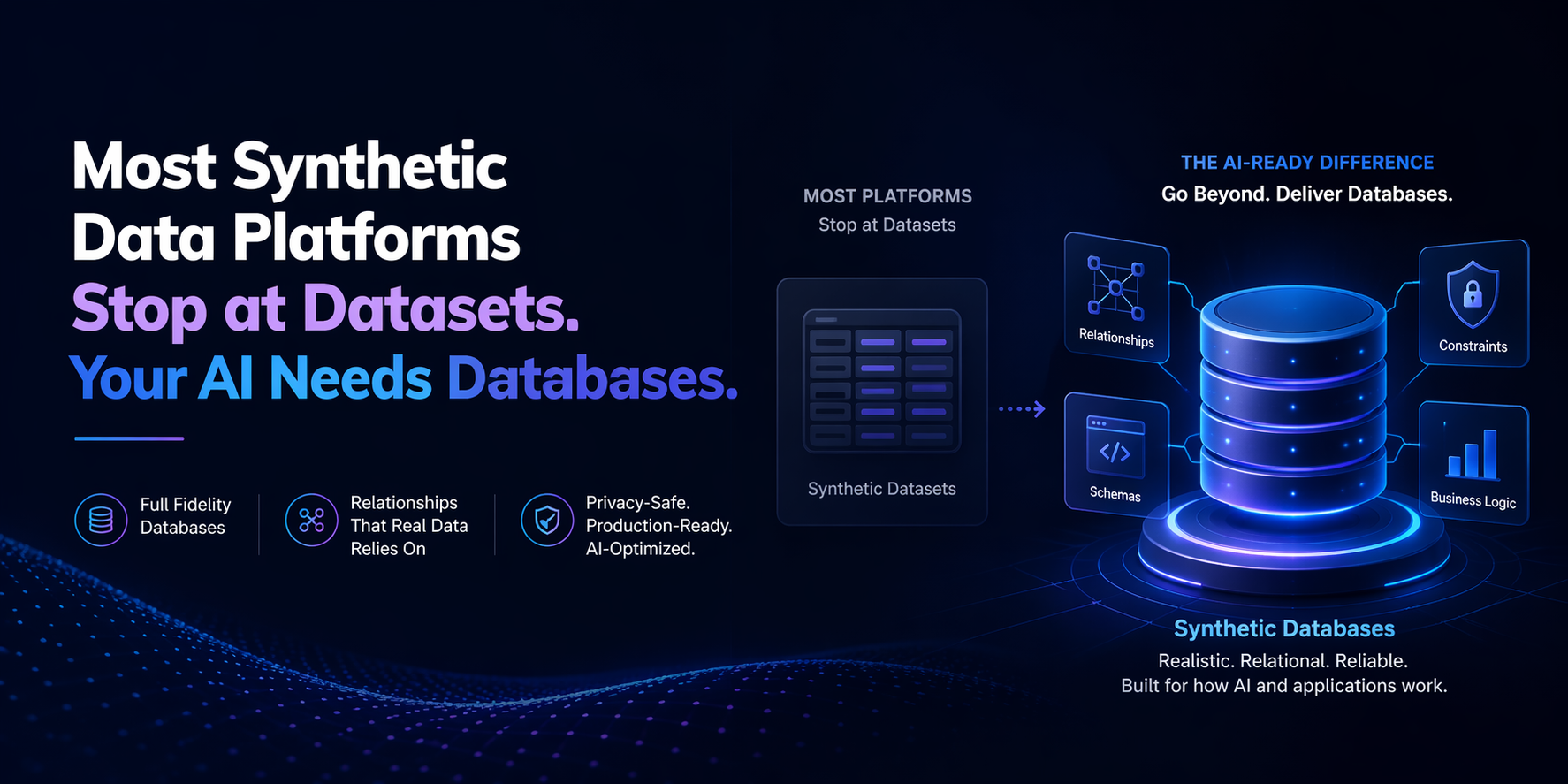
  • Most Synthetic Data Platforms Stop at Datasets. Your AI Needs Databases.

    Most Synthetic Data Platforms Stop at Datasets. Your AI Needs Databases.

    Most Synthetic Data Platforms Stop at Datasets. Your AI Needs Databases.

    Why AI teams that care about production reality are moving from synthetic CSVs to synthetic systems.

    The Real Bottleneck Is Not Models. It Is Test Environments.

    If you are running an AI product in finance, insurance, or healthcare, you already know the ugly truth. The hard part is not training another model. The hard part is keeping a production-like environment where data, schemas, queues, and services behave like the real world without violating privacy.

    You can get a synthetic CSV from almost any tool. It looks statistically plausible in isolation. But when your backend expects 30 tables stitched together with foreign keys, slowly changing dimensions, event streams, and authorization rules, a nice-looking dataset is useless. Your team hacks together one-off scripts, breaks referential integrity, and spends weeks debugging test failures that have nothing to do with the model itself.

    SyntheholDB exists for that gap.

    Datasets vs Databases Is Not Semantics. It Is Why Pilots Die.

    Most synthetic data platforms were designed for analytics teams. They give you a table. Maybe a handful of tables. That is enough if your use case is a one-off model experiment in a notebook.

    Your world is different:

    • Your product reads from an OLTP database, not a single CSV.
    • Your pipelines assume consistent primary and foreign keys across dozens of tables.
    • Your compliance team will not let you clone production into dev any more.
    • Your incident history is full of bugs that only show up when the whole system runs together, not in a lab dataset.

    So you get stuck in a bind:

    • Use basic synthetic tables and hope your integration tests do not lie.
    • Or keep “golden copies” of real data in hidden dev environments and hold your breath.

    Neither scales. Both are risky. And both ignore what actually matters to you: can we safely recreate our production system so we can move faster without breaking things or leaking PII.

    What SyntheholDB Actually Does (In Terms That Matter to You)

    SyntheholDB does not start from “generate a table with N rows.” It starts from “recreate the behavior of this system.”

    Practically, that means:

    • You define or import your real schema: 10, 30, 100+ tables.
    • SyntheholDB learns the joint behavior of entities across those tables from safe samples or aggregated patterns.
    • It generates a complete synthetic database that preserves:
      • Full schema fidelity
      • Referential integrity and key constraints
      • Cross-table and temporal correlations
      • Business rules that actually matter (for example: no claim without a policy, no transaction without a KYC-ed account)

    The outcome is not just “fake data.” It is a drop-in, production-safe database you can load into Postgres or your cloud warehouse and start running your pipelines, services, and tests against.

    You can see the overall Synthehol platform here:
    <https://synthehol.ai>

    And you can work directly with SyntheholDB here:

    What Excites Serious Data Leaders (And How SyntheholDB Delivers)

    When we talk with heads of data and ML at banks, insurers, and healthtech companies, they are excited by features, but they buy for different reasons:

    1. You finally get realistic dev and staging environments without begging Legal.
      Synthetic databases from SyntheholDB are non-identifiable by design, so infra and ML teams can self-serve test environments.
    2. Your integration and regression tests stop lying to you.
      You can simulate month-end loads, high-cardinality edge cases, and multi-entity workflows that only emerge when the whole graph of tables is in play.
    3. You can safely share realistic data beyond your walls.
      Vendors, SIs, offshore dev teams, and internal hackathons can work on data that behaves like production without anyone losing sleep over re-identification.
    4. You compress months of “data plumbing” into minutes.
      Instead of your senior engineers writing fragile generation scripts, they give SyntheholDB a schema and constraints and get a database back.

    SyntheholDB is not exciting because it is another AI tool. It is exciting because it unlocks engineering work you currently cannot do at all under your regulatory and operational constraints.

    A Concrete Example from Your World

    Imagine you are a fintech with:

    • 18 core tables in production
    • 6 services hitting the same database
    • 3 regions with slightly different regulatory rules

    Today, spinning up a new environment means:

    • Coordinating with security to get a scrubbed snapshot
    • Running brittle anonymization scripts that break joins
    • Hand-fixing foreign keys for days
    • Telling your team “staging is flaky, do not trust the data beyond basic flows”

    With SyntheholDB:

    • You give us your schema and a representative profile of the real system.
    • You define constraints and policies once.
    • You click Generate and get a synthetic database that:
      • Respects your schemas
      • Obeys your business rules
      • Is safe to ship to any region or vendor

    You can start this same journey from the hosted platform:
    Generate your first synthetic database at https://db.synthehol.ai/.

    Who SyntheholDB Is For (And Who It Is Not For)

    SyntheholDB is built for teams who:

    • Run complex transactional systems, not just dashboards
    • Need to prove privacy protection to regulators and auditors
    • Treat non-production environments as first-class citizens, not afterthoughts
    • Are tired of treating test data as a one-off script instead of a platform capability

    It is probably not for you if:

    • You just want a sample CSV for a tutorial
    • You do not care about schemas, constraints, or end-to-end flows
    • You are okay with copying production into dev and accepting the risk

    If that is you, simpler tools will do.

    Ready To See Your Own System, Synthetic and Safe?

    You do not need a six-month project to know if this fits your world.

    • Start with one system: your core transactional database.
    • Point SyntheholDB at the schema, define your constraints, and generate your first synthetic environment.
    • Run your existing tests and pipelines on it. See what still fails and what suddenly becomes possible.

    If you are responsible for keeping AI and data products from breaking in production, SyntheholDB gives you something you do not currently have: a realistic, defensible, fully synthetic copy of your world to build in.

    See what your production system looks like, fully synthetic and safe.
    Start a SyntheholDB trial and generate your first database in under an hour.
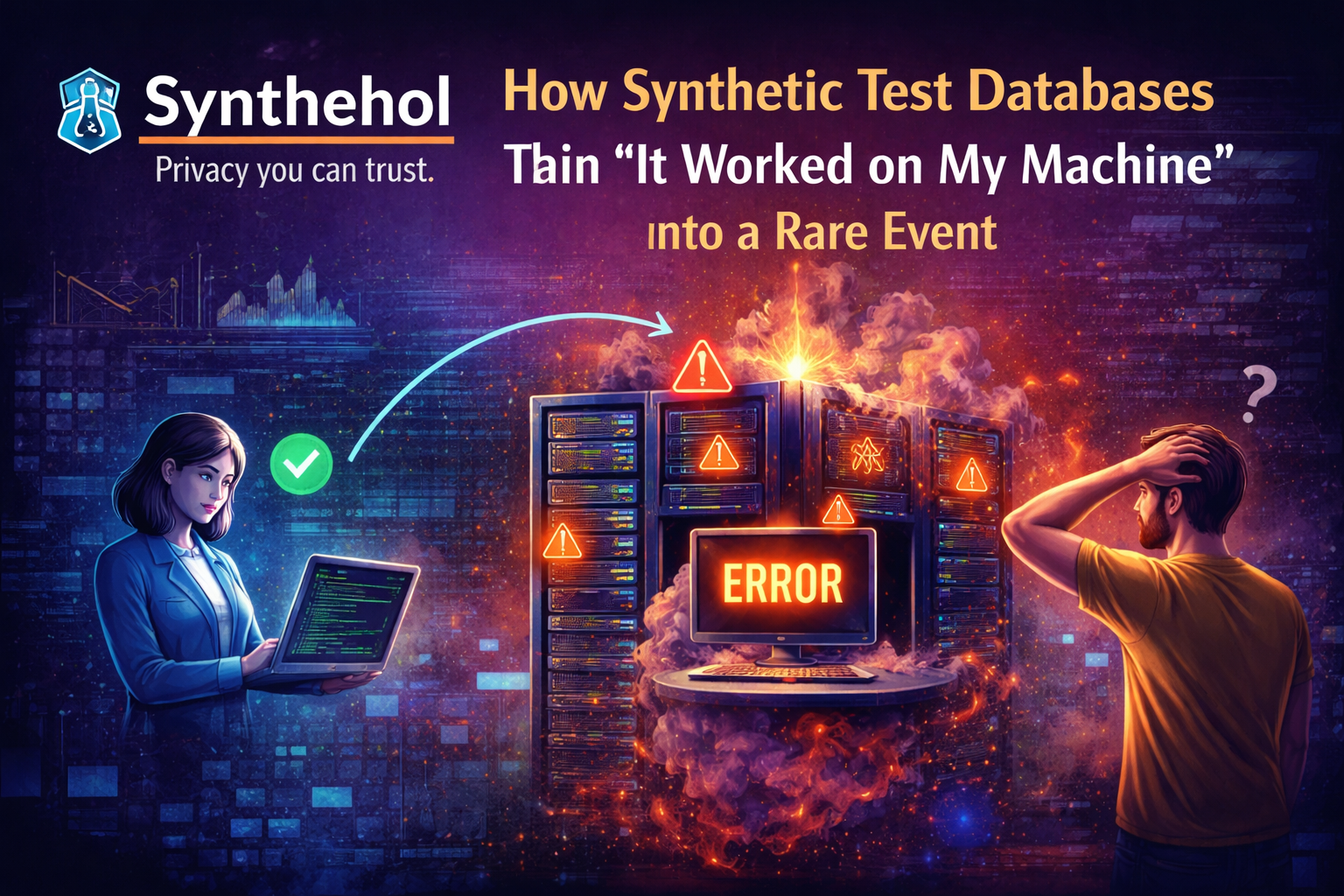
  • How Synthetic Test Databases Turn “It Worked on My Machine” into a Rare Event

    How Synthetic Test Databases Turn “It Worked on My Machine” into a Rare Event

    Why realistic, privacy‑safe databases are the missing piece in reliable testing pipelines.

    Introduction: the real cost of “works on my machine”

    Every engineering team has a version of the same story: a feature passes all tests in dev, sails through QA, and then explodes in production in the first 10 minutes. The root cause almost always traces back to data. The code path was fine; the test database was not.

    Most lower environments are powered by one of three options:

    • A stale copy of production from “some time last quarter”
    • A heavily masked subset that no one fully understands
    • A hand‑crafted dummy dataset that looks nothing like reality

    None of these are good enough if you care about reliability, privacy, or speed. That’s the gap SyntheholDB is built to close.


    The core problem: environment drift is a data problem

    We talk about environment drift as if it’s just configuration: different feature flags, different infra, different versions of a service. But underneath that, there’s a quieter, nastier drift happening in the data itself.

    Over time:

    • New edge cases show up only in production
    • Distributions shift (a field that was “sometimes null” is now “almost always null”)
    • New tables and relationships get added without making it into test datasets

    Your test database slowly stops representing the real world. The result is predictable: bugs only show up when real users are on the line.

    SyntheholDB’s job is to keep your test databases statistically close to production, structurally correct, and completely free of real user data.

    What a synthetic test database actually is

    When we say “synthetic test database” with SyntheholDB, we mean something very specific:

    • The same schema as production (tables, columns, constraints).
    • The same relationships (foreign keys, many‑to‑many, cascades) enforced.
    • Data that matches real‑world distributions and edge cases, but is generated, not copied.
    • Zero direct link back to any real person or account.

    You keep all of the behavior that matters for testing—joins, aggregations, tricky edge cases—without the risk and overhead of copying production data around.


    How SyntheholDB changes day‑to‑day engineering work

    Here’s what changes once teams start using SyntheholDB as their default for staging and test:

    1. New services don’t block on “getting data”
      Spinning up a new environment no longer means begging ops for a sanitized dump. You define the schema or connect to an existing one, tell SyntheholDB how big you want it, and generate a fresh database on demand.
    2. Repro steps actually reproduce
      When a production bug is tied to a weird combination of values, you can encode that pattern into the generation config and regenerate the environment. Now that “impossible” state is part of your standard test data.
    3. CI becomes less flaky
      Instead of a single shared test DB that’s constantly being mutated, you can generate isolated synthetic databases per test run, per branch, or per suite. Tests stop stepping on each other’s data.
    4. Security stops being the bottleneck
      No more long review cycles around “Can we use this prod dump for this vendor / hackathon / POC?” The data is synthetic by design, so you can move faster without negotiating exceptions every time.

    A concrete example: onboarding a new microservice

    Imagine you’re introducing a new billing microservice that relies on:

    • Customer profiles
    • Subscription plans
    • Invoices and payments
    • Feature flags and discounts

    In a traditional setup, you would:

    • Request a masked subset of prod
    • Wait days or weeks for it to be prepared and approved
    • Discover late that important edge cases were removed by masking

    With SyntheholDB, the flow looks different:

    1. Point SyntheholDB at your existing schema (or define it via the UI / config).
    2. Describe a few critical scenarios in plain language or via templates:
      • “Customers with overlapping subscriptions”
      • “Invoices with partial payments and chargebacks”
      • “Long‑tail currencies and tax rules”
    3. Generate a synthetic database that includes those patterns at the frequency you want.
    4. Spin up as many identical or variant environments as you need across dev, QA, and CI.

    The billing team ends up testing against a rich, realistic dataset from day one, without ever touching real payment data.

    Why not just mask production data?

    Masking sounds attractive because it starts from something “real.” In practice, it introduces its own set of problems:

    • Masking often breaks referential integrity, especially when done in a hurry.
    • Clever attackers (or just bad luck) can still expose patterns that are too close to real users.
    • You’re still copying production records into places they don’t belong.

    Most teams doing masking end up with data that’s neither fully safe nor fully realistic. Synthetic data flips the model: we start from privacy and realism as requirements, not as afterthoughts.

    Where SyntheholDB fits in your stack

    SyntheholDB is not meant to replace your production database, your observability tools, or your data warehouse. It plugs into the parts of your stack where you need realistic behavior without real users:

    • Developer sandboxes
    • Shared QA / UAT environments
    • CI pipelines and ephemeral test environments
    • Demo and sales environments that can show “real” flows without real PII

    In each case, you get a database that feels like prod in all the ways that matter for testing, while being safe to share, reset, and experiment with.


    What to measure after adopting synthetic databases

    If you roll out SyntheholDB, here are a few metrics worth tracking over the next few months:

    • Number of prod incidents caused by data assumptions
    • Time taken to spin up a fully functional test environment
    • Number of data‑related security exceptions or review cycles needed
    • Flaky test rate in CI (especially for integration tests)

    Teams that take this seriously usually see fewer “surprise” bugs, faster release cycles, and happier security reviewers.

    Closing: making “works on my machine” rare

    “It worked on my machine” is not a law of nature. It’s a symptom of unrealistic, inconsistent, and unsafe test data.

    By treating the test database as a first‑class product and generating it synthetically instead of copying prod you give engineers a shared, reliable view of reality they can safely break, reset, and iterate on.

    That’s exactly what SyntheholDB is designed for: realistic test databases that help you ship faster, avoid incidents, and keep real user data where it belongs.