Why SyntheholDB is the best compared to Gretel.ai?
Synthetic data has become a cornerstone of modern software development, AI innovation, and data privacy initiatives. Organizations across healthcare, banking, insurance, life sciences, and government sectors are increasingly turning to synthetic data to accelerate testing, analytics, and machine learning projects without exposing sensitive information.
While many synthetic data platforms focus on generating realistic records for AI training, enterprise organizations face a much bigger challenge: creating complete, production-like databases that maintain complex relationships, business rules, and compliance requirements.
This is where Synthehol DB stands apart.
If you’re evaluating a Gretel.ai alternative for enterprise-scale synthetic data generation, understanding the difference between synthetic datasets and synthetic databases is critical.
The Growing Enterprise Need for Synthetic Data
Data is the fuel behind digital transformation initiatives, but privacy regulations, security concerns, and governance requirements often limit how organizations can use production data.
Development teams need realistic test environments.
QA teams require representative datasets.
Analytics teams need access to production-like data.
Vendors need data for solution validation.
Yet sharing or replicating sensitive customer, patient, or financial information introduces significant risk.
Synthetic data solves this problem by creating statistically representative data that preserves utility while eliminating exposure to real individuals.
However, not all synthetic data solutions are built for enterprise complexity.
The Limitation of Single-Table Synthetic Data
Many organizations begin their synthetic data journey with a straightforward use case: generating synthetic records for machine learning or analytics.
While useful, these approaches often focus on individual tables rather than entire relational systems.
The challenge becomes apparent when organizations attempt to recreate real-world environments.
Consider a healthcare database:
- Patients
- Appointments
- Providers
- Diagnoses
- Prescriptions
- Claims
- Billing records
- Lab results
Each table depends on multiple relationships.
The same applies to banking systems, insurance platforms, ERP environments, CRM databases, and enterprise applications.
Generating synthetic rows is relatively easy.
Maintaining foreign key integrity, preserving relationships, and ensuring realistic business logic across dozens of interconnected tables is significantly harder.
Why Synthehol DB Was Built Differently
Synthehol DB was designed specifically for organizations that need more than synthetic datasets.
It was built for synthetic databases.
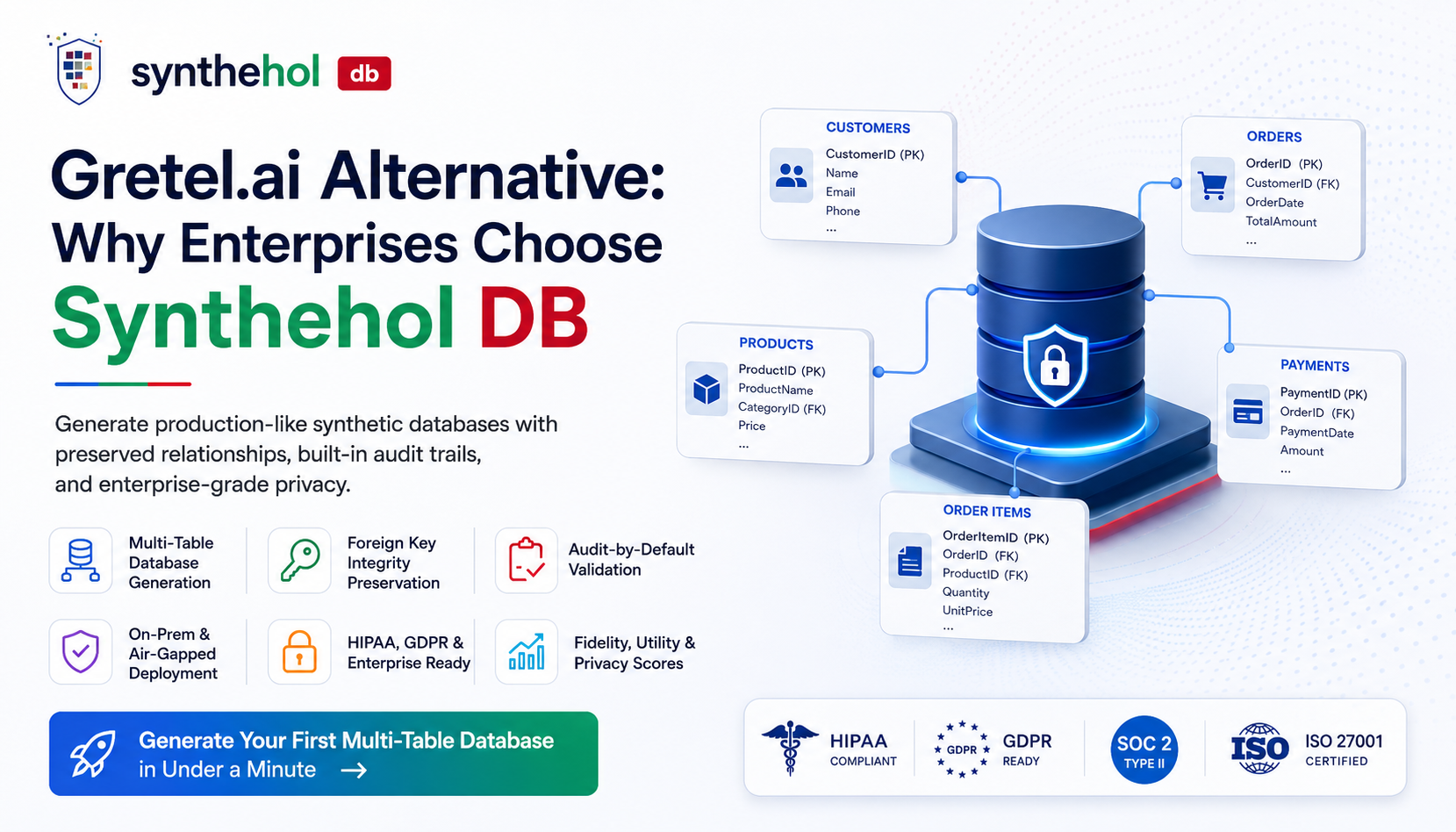
Rather than focusing solely on tabular data generation, Synthehol DB creates production-like relational databases while preserving:
- Foreign key relationships
- Parent-child dependencies
- Multi-table joins
- Complex schemas
- Business rules
- Referential integrity
This allows engineering, QA, and analytics teams to work with realistic environments that closely mirror production systems without exposing sensitive information.
For enterprises operating large-scale applications, relational integrity isn’t optional—it’s essential.
Built for Regulated Industries
Organizations in regulated industries face unique challenges when adopting synthetic data solutions.
Compliance teams need transparency.
Security teams need validation.
Governance teams need documentation.
Synthehol DB addresses these requirements through an audit-first approach.
Every synthetic data generation run automatically includes:
Fidelity Metrics
Measure how closely synthetic data reflects the characteristics of the source data.
Utility Scores
Validate whether the synthetic data remains useful for testing, analytics, and development purposes.
Privacy Assessments
Provide evidence that sensitive information cannot be reconstructed or linked back to real individuals.
Audit Artifacts
Create documentation that can be shared with security, compliance, and governance stakeholders.
Instead of treating validation as a separate process, Synthehol DB makes it part of every generation workflow.
Enterprise Deployment Without Compromise
Many enterprises operate under strict infrastructure and security requirements.
Cloud-based solutions aren’t always an option.
Healthcare organizations, financial institutions, government agencies, and defense contractors frequently require:
- On-premises deployment
- Air-gapped environments
- Internal-only processing
- Complete infrastructure control
Synthehol DB provides native support for enterprise deployment models, including fully air-gapped environments where sensitive data never leaves organizational boundaries.
This flexibility allows enterprises to adopt synthetic data without introducing new security concerns.
Research-Driven Synthetic Data Generation
Enterprise buyers increasingly demand transparency around how synthetic data is generated.
Synthehol DB is backed by four published research papers that inform the platform’s underlying generation methodologies.
This research-driven foundation helps organizations evaluate synthetic data quality with confidence while providing visibility into the techniques used to preserve privacy and maintain utility.
For technical teams, understanding the science behind the platform is often as important as understanding the feature set.
Common Synthehol DB Use Cases
Organizations use Synthehol DB to accelerate a wide range of initiatives, including:
Software Testing
Generate realistic test databases without exposing production data.
Quality Assurance
Validate applications using production-like environments.
User Acceptance Testing
Create safe environments for business users to validate workflows.
Vendor Evaluation
Share realistic datasets with external vendors without exposing sensitive information.
Data Sharing
Enable collaboration across departments, partners, and third parties.
Analytics Development
Allow analysts to build dashboards and reports using representative datasets.
AI and Machine Learning Preparation
Generate realistic relational data environments for model development and validation.
Why Enterprises Are Looking Beyond Traditional Synthetic Data Platforms
The synthetic data market has matured rapidly.
Organizations are no longer evaluating platforms based solely on their ability to generate synthetic records.
Instead, they are asking more sophisticated questions:
- Can the platform preserve complex database relationships?
- Can it support large-scale enterprise schemas?
- Does it provide built-in auditability?
- Can it operate within regulated environments?
- Does it support on-premises deployment?
- Can compliance teams trust the outputs?
These questions reflect the realities of enterprise adoption.
Synthetic data is no longer an experimental technology.
It has become critical infrastructure for modern software development, testing, and AI initiatives.
Why Synthehol DB Is a Strong Gretel.ai Alternative
Organizations evaluating Gretel.ai alternatives are often searching for a platform that goes beyond synthetic datasets and supports enterprise-scale relational database generation.
Synthehol DB delivers:
- Multi-table synthetic database generation
- Foreign key integrity preservation
- Deep relational schema support
- Audit-by-default validation
- Privacy and utility scoring
- On-premises and air-gapped deployment
- Research-backed generation methodologies
- Enterprise-grade governance capabilities
For teams working with complex, regulated, production-scale environments, these capabilities can significantly reduce risk while accelerating innovation.
Get Started with Synthehol DB
Synthetic data should eliminate bottlenecks—not create new ones.
Whether you’re building test environments, enabling secure data sharing, validating vendor solutions, or accelerating AI development, Synthehol DB helps organizations generate realistic, compliant, production-like databases in minutes.
Start free and generate your first multi-table synthetic database today.
Because when relationships matter, synthetic rows aren’t enough.
Leave a Reply